The Gauntlet
Be the firm everyone can say yes to.
Show your partners which line would lose the pitch, and why.
Every pitch your firm sends is a best guess. That guess could cost you the work if a single line makes the client say no.
The Gauntlet is your chance to find that line before the client does.
We run The Gauntlet for you. You send us your pitch. As fast as 24 hours later, we send back a report. The report shows you which role could stop your pitch, why and what to say back.
How to test a pitch before it goes to the client
To test a pitch before it goes to the client, The Gauntlet creates Client Proxies. Client Proxies are AI-powered models of the decision-making roles. You might have Client Proxies of the general counsel and the COO, or of the CFO and a member of the audit committee. The test looks for any reason someone in those roles would say no.
You could ask a colleague to read your pitch, offer or message as the client. But a colleague misses two things. First, they know your firm, so they can’t read your pitch as a client would. Second, they aren’t in the role that decides at your client.
Client Proxies include the roles you never meet, the ones behind the scenes who shape the client’s decision.
Each Client Proxy plays a role, not a person. You can’t test your pitch on your client’s CFO before the meeting. You can test your pitch on a CFO in the same position: say, the CFO of a mid-sized bank under pressure to cut costs. That role has reasons to say no, and the test finds them.
Those reasons change with things nobody can know in advance. So we vary each role, using what we learn from speaking to you and from our research. One procurement lead is under orders to cut suppliers; another isn’t. One head of team decides alone; another takes the decision to their own boss.
The Gauntlet runs multiple variations of your pitch past dozens of versions of the roles who decide if you get the work.
Then we write versions. A version is your whole pitch, with one or more of its critical points written another way. You send your version, and we write the others.
Each version then goes to the Client Proxies. When a Client Proxy says no, we test replies to find what turns that no around. A version with a reply that overcomes a Client Proxy’s reason to say no moves on to the next role, with the reply built in. A version one role stops goes no further. The goal of The Gauntlet is to give you the version no Client Proxy stops. If every version is stopped, you know which role stopped each version, and why, before the client does.
What each Client Proxy knows comes from the sector, the pressures of the job and your team’s experience of the role. That knowledge never comes from your client files, from anything this client or prospect has told you, or from anything about a named person or organisation.
The same pitch, three ways
Say you’re pitching a second service to a client. The Client Proxies for a head of operations like the idea: one firm for both, fewer pieces to manage. The Client Proxies for a procurement lead stop the pitch: too many eggs in one basket.
A second version changes the offer. The new service will be run by a separate team, and the client can cancel it without affecting the first service. Procurement is satisfied: being able to cancel makes the risk acceptable. But now the head of operations says no: two teams is no longer fewer pieces to manage.
A third version keeps the right to cancel, but goes back to one team. The head of operations has fewer pieces to manage, and procurement can still cancel. Neither role has a reason to say no.
Three versions of one pitch, and which role’s Client Proxies stop each.
From inside your firm, you’d probably write one of those three versions, and judge your version from your side, not the client’s. We write the other two from your version, and The Gauntlet tests all three and shows you the version no role stops.
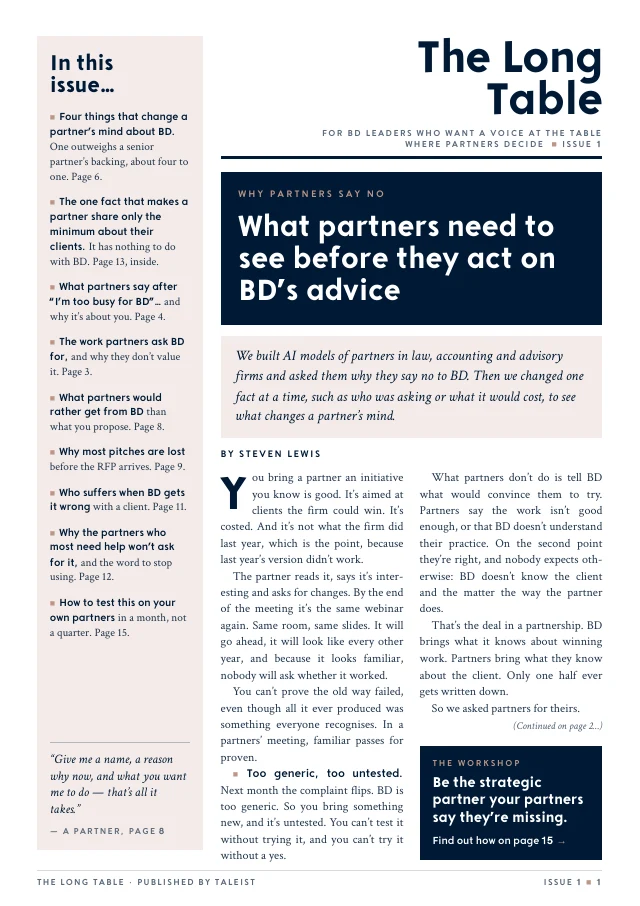
What a Gauntlet report finds in a panel response
A Gauntlet report is confidential to the firm that commissions it, so we can’t show you a real report. This sample shows you what you’d get. The pitch is typical: a mid-sized law firm’s executive summary for a large Australian ports and logistics operator’s legal panel, asking to add infrastructure, regulatory and disputes work to the property and employment work it already holds. The Client Proxies are the four roles that decide: the general counsel, the procurement lead, the CFO and the chief executive.
In the test, the draft lost the general counsel in every situation we set up. The CFO and chief executive sided with the general counsel. The revised version kept all four roles reading, on conditions the firm can meet.
What the test found
- A strength that read as a warning. The draft said its disputes practice “has grown this year with two senior lateral appointments”. Every role read the line as a team still forming. The CFO called the line “a warning dressed as a strength”. With the line cut, no role missed it.
- The best line, in the wrong place. Mid-paragraph, the draft said “the team that drafts the client’s project contracts would be the team that runs any dispute under them”. Every role chose that point to repeat. Moved to the first line, the point became the sentence the chief executive would repeat in every situation we set up.
- A question the draft left open. What happens to cost if a project goes into dispute? One line answered the question: a budget for each stage, with written notice before any stage budget is exceeded. The CFO stopped asking whether the fee caps survive a dispute.
- An answer that made things worse. Once they heard the concern that one team would be reviewing its own drafting, every role took the concern up. Three written answers each raised that concern with a role that hadn’t thought of it. So the answer stays out of the summary and goes into the firm’s preparation for the meeting.
Here’s what the test took:
Even your best writer sends one version, picked by instinct. The Gauntlet tests each change on its own, then the combinations, to find the version no Client Proxy stops.
The version no Client Proxy stops isn’t a yes. It’s the version that leaves the people who decide the fewest reasons to say no and the most to repeat.
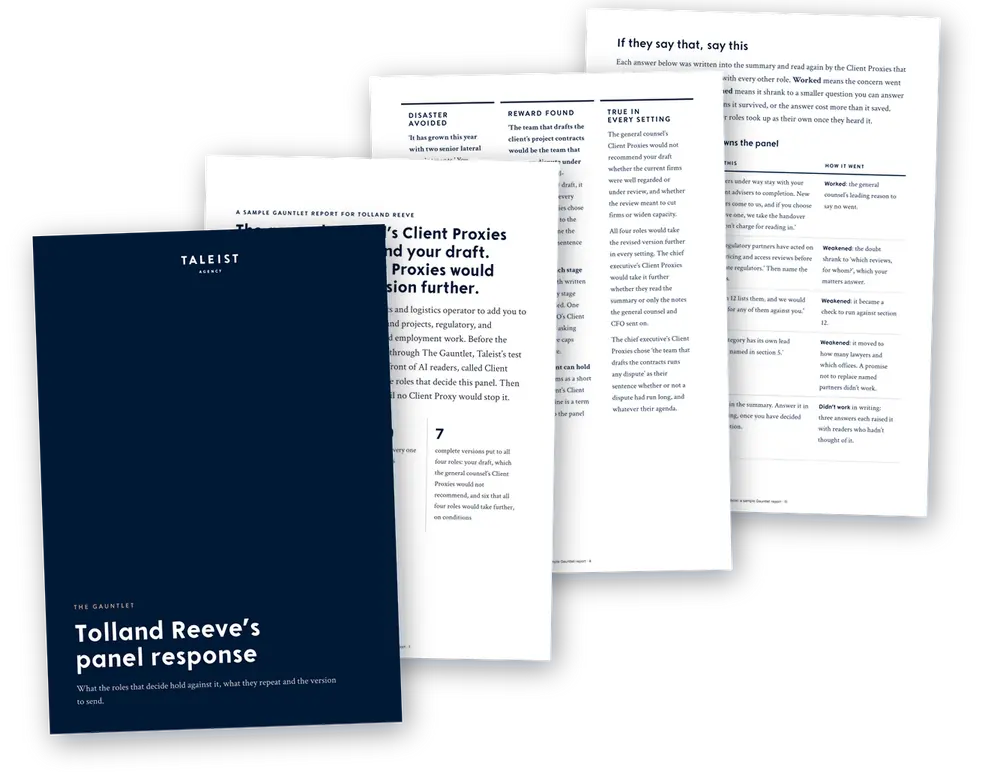
The full sample report, 30 pages. Names and details are illustrative.
Why not ask ChatGPT?
One prompt to ChatGPT gets you one opinion of one version. Ask again and you get the same opinion, reworded. The Client Proxies run on the same kind of models, OpenAI’s among them. The difference is the set-up: many Client Proxies, each set a different way, kept apart so one answer can’t colour the next, with a record of which setting produced each answer.
What happens, and what you get
- Fill in a short questionnaire
Describe the sector broadly enough to fit several organisations. Tell us the roles that decide, and your team’s general experience of people in those roles. Send your pitch, and any other versions you’re already weighing. We write the alternatives to test against your pitch. Anonymise your pitch before you send it: we give you a prompt for your own AI to do that. The FAQ lists what not to send.
- Take an intake call
We’ll ask what’s decided, what can still change, which roles decide, which sign off and which would argue for doing nothing. We talk about roles, not people. We don’t need your client’s name. If we hear the name, it never goes into the AI, so no model is ever built of your client or its people.
- Come to the debrief
How long a run takes: as fast as 24 hours, or the same day if you book ahead.
What a run asks of your partners: one call at most. A partner may join the intake call or the debrief, and nothing else.
What we do
- We test what happens when your pitch is forwarded upstairs: what the next role still sees, what drops out and what turns into a promise you never made.
- We work out which roles decide: which are in the meeting, which the pitch gets forwarded to, and which sign off without ever taking the meeting.
- We write the alternatives, build Client Proxies for each role, and test every version, opening and reply, role by role.
What you get: a report, as a web page and a PDF
- The version to send, and every opening tried.
- How your pitch travels. What each role takes from your pitch, passes on and still needs.
- If they say that, say this. Every reason to say no the Client Proxies raised, the reply that persuaded them, and how each reply went.
- Your pitch, before and after. What your pitch said, what the new version says and which role’s Client Proxies made the difference.
- The price. How to put your fee, if your pitch carries a fee.
- In the meeting, find out first. The questions that answer what nobody could know in advance.
- A named person at Taleist to call before the meeting.
- The work, counted. How many readings, how many words of feedback, and the version no Client Proxy stopped.
When to use The Gauntlet
For moments with a date on them and money on the line: a pitch, a change to fees or terms, a key-account plan, a new service or a plan aimed at your clients, such as a plan for a strategy day. For a plan, the Client Proxies are the clients the plan is aimed at, never your partners.
See a Gauntlet report for yourself
The walkthrough takes you through the sample report: every version, every reason to say no and every reply tried. Prefer to read the report first? Request the sample report.
Nothing in the walkthrough involves your work.
Questions
Will The Gauntlet tell us whether the client will say yes?
No, and nothing honest can before the meeting. The Gauntlet tells you which role could stop your pitch, why and which replies persuaded each role’s Client Proxies. You can show those findings to your partners, with no probability in them to argue about.
Does The Gauntlet test our price?
The Gauntlet tests how you put the fee to the client, never the number. Ask a Client Proxy whether a figure is too high and they say yes, because you asked. So a tested figure would tell you nothing. The figure is your call.
How do you know The Gauntlet works?
The Gauntlet shows you how someone in each role would reason about your pitch. It can’t tell you what one client will decide. Read the sample report and judge the reasons for yourself: would a general counsel you know say the same? You don’t have to take the Client Proxies’ word for it. The report gives you questions to ask in the meeting, so your partners find out which reasons the client holds.
Can we see a real report?
No. A report is confidential to the firm that commissions it, as your report would be. The sample report shows you the format, the depth and the kind of finding you’d get.
What do you need from us?
For the walkthrough, nothing. To run The Gauntlet on your own pitch, offer or message: the sector, described broadly; the roles that decide; your team’s general experience of people in those roles; and your version. We write the alternatives to test against your version.
How is The Gauntlet different from ASI?
Put new terms to all your banking clients, and that’s ASI. Put new terms to one bank, and that’s The Gauntlet. ASI is Taleist’s market research service. It configures hundreds of Client Proxies, across every dimension that matters in a market, and asks them many questions. It tells you how a whole market thinks, and how widespread each view is. The Gauntlet configures Client Proxies for each role in one decision, on only the dimensions that matter for that role, and asks one question: how do they reason about your pitch? Its findings are reasons, replies and wording, never counts of who agreed.
Is The Gauntlet another tool to roll out?
No. It’s a service, not software: nothing to install, no new login. You get a report, as a web page and a PDF.
For your COO
What happens to our information?
You don’t send us confidential material, and we won’t take it: no client files, emails, call notes, CRM records, invoices or fee disputes, and nothing a client or prospect has told you. Before you send anything, you take out the client’s name, the names of its people and anything else that would identify either, and we give you a prompt for your own AI to do it. Everything we take in and send back is text. We don’t need your client’s name. If we hear the name, it never goes into the AI, so no model is ever built of your client or its people. We keep what you do send us in Taleist’s own systems, siloed from every other client’s work, and use it for your run and nothing else. The Client Proxies run on Anthropic’s Claude and OpenAI’s models, through their business services, and neither trains its models on what we send. We delete your material 90 days after we hand over the report. We’ll send our terms and a data processing agreement with the proposal.
Is a Client Proxy a digital twin?
No. A digital twin is built to play a named person. We don’t build digital twins, and we’d suggest you don’t either. A model built to play a named person, from what you know about them, is considered personal information by regulators, which means you need the person’s permission to model them. For law and accounting firms, much of what you know about a client’s people is also your client’s confidential information. We aren’t lawyers, and this isn’t legal advice, so you should speak to your lawyer about your situation. However, we do not build digital twins. We build Client Proxies for roles, not people, and vary each role across the things nobody can know in advance.
Book the walkthrough
See what a Gauntlet report shows you
Book a walkthrough and we’ll take you through the sample report, version by version. Nothing in the report involves your work.
Prefer email? asi@taleist.agency
Tell us the pitch or decision in front of you and we’ll reply within one business day.